

resources
Potassium Nitrate: Applications Across Agriculture and Industry
Aug
Potassium nitrate (KNO₃), commonly known as saltpeter, is a naturally occurring compound that has been utilized for centuries due to its oxidizing properties and solubility. It plays a significant role in various sectors, including agriculture, industry, and food preservation
Table of Contents
- Chemical Composition and Properties
- Agricultural Applications
- Role in Plant Nutrition
- Fertilizer Formulations
- Benefits in Crop Production
- Industrial Applications
- Use in Pyrotechnics and Explosives
- Role in Glass and Ceramics Manufacturing
- Application in Food Preservation
- Use in Pharmaceuticals and Personal Care
- Environmental and Safety Considerations
- Frequently Asked Questions (FAQs)
Chemical Composition and Properties
-
Chemical Formula: KNO₃
-
Molecular Weight: 101.1 g/mol
-
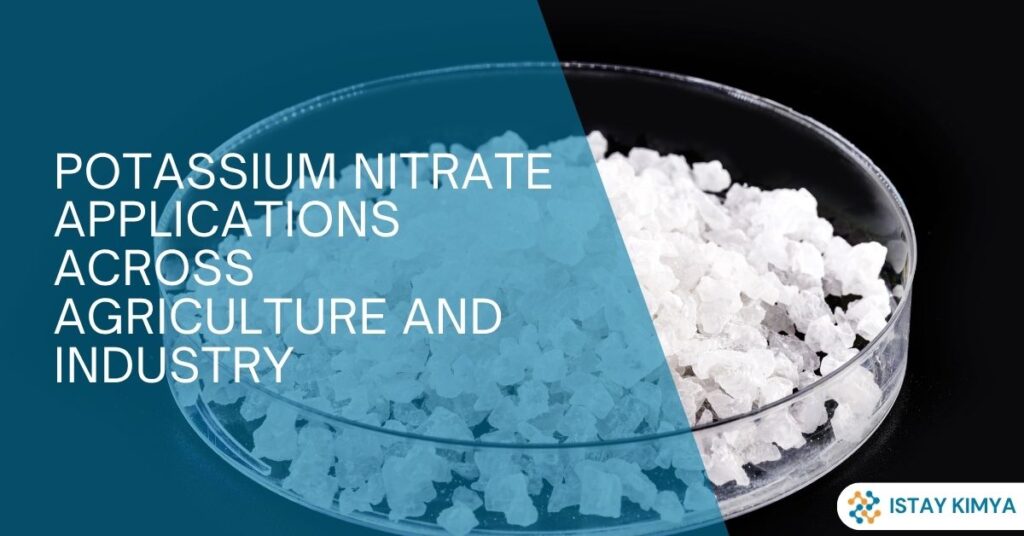
Appearance: White crystalline solid
-
Solubility: Highly soluble in water
-
Melting Point: 334°C
These properties make potassium nitrate an effective oxidizing agent and a valuable component in various applications.
Agricultural Applications
Role in Plant Nutrition
Potassium nitrate provides essential nutrients—potassium and nitrogen—that are vital for plant growth. Potassium aids in water regulation and enzyme activation, while nitrogen is crucial for protein synthesis.
Growers building soluble feed programs often combine it with calcium nitrate for fertigation and greenhouse feeding, which supplies calcium alongside fast-acting nitrate nitrogen.
Fertilizer Formulations
In agriculture, potassium nitrate is used in various fertilizer formulations, often labeled as 13-0-46, indicating the percentages of nitrogen, phosphorus, and potassium, respectively.
Where chloride-sensitive crops or sulfur requirements call for a different potassium source, chloride-free potassium sulfate (SOP) is a common alternative in fertilizer programs.
Benefits in Crop Production
-
Enhanced Yield: Improves crop productivity by supplying readily available nutrients.
-
Disease Resistance: Strengthens plant cell walls, making them more resistant to pathogens.
-
Improved Quality: Enhances the taste, color, and shelf-life of fruits and vegetables.
Industrial Applications
Use in Pyrotechnics and Explosives
Potassium nitrate is a key component in the manufacture of fireworks and explosives due to its oxidizing properties. It facilitates the rapid combustion necessary for these applications.
Role in Glass and Ceramics Manufacturing
In the glass industry, potassium nitrate is used to strengthen glass through a process called ion exchange. It replaces sodium ions in the glass with potassium ions, enhancing durability.
Other nitrate salts fill comparable oxidizing and glass-treatment roles in manufacturing; our guide to sodium nitrate applications in glass and explosives outlines where each compound fits.
Application in Food Preservation
As a food additive (E252), potassium nitrate is used to preserve meats, preventing bacterial growth and maintaining color.
Use in Pharmaceuticals and Personal Care
Potassium nitrate is found in toothpaste formulations to alleviate tooth sensitivity by calming dental nerves.
Environmental and Safety Considerations
While potassium nitrate is beneficial in various applications, it must be handled with care:
-
Storage: Should be stored in a cool, dry place away from combustible materials.
-
Handling: Use protective equipment to prevent skin and eye contact.
-
Environmental Impact: Overuse in agriculture can lead to nitrate leaching into water sources, causing eutrophication.
Frequently Asked Questions (FAQs)
Q1: What is the primary use of potassium nitrate in agriculture?
A1: It serves as a fertilizer, providing essential potassium and nitrogen to plants, enhancing growth and yield.
Q2: Is potassium nitrate safe for use in food preservation?
A2: Yes, when used within regulated limits, it is safe and effective in preserving meats by inhibiting bacterial growth.
Q3: Can potassium nitrate be used in organic farming?
A3: Its use in organic farming is restricted and subject to certification standards, as it is a synthetic compound.
Q4: How does potassium nitrate alleviate tooth sensitivity?
A4: It calms the nerves in the teeth by blocking the transmission of pain signals, providing relief from sensitivity.
Q5: What precautions should be taken when handling potassium nitrate?
A5: Use protective gear, store it properly, and avoid mixing with combustible materials to prevent accidents.
For more information or to purchase potassium nitrate, visit Istay Kimya’s product page.
